
Every poultry operation reaches a point where the feed bill stops being just a number and starts being a question. You look at the invoices, you look at the flock, and you wonder whether there is a better way. The birds are eating. They are growing. They are laying. But the margin between what you spend on feed and what you earn from the flock keeps getting thinner. At some point, the question becomes unavoidable: should you make your own feed?
The answer is not the same for everyone. A small backyard flock does not need a production line. A large integrated operation probably already has one. The interesting cases are in the middle—the farms that are big enough to benefit from on-site production but small enough that the decision still feels risky. For those operations, the choice comes down to a handful of practical factors: volume, consistency, equipment, and the willingness to learn a new part of the business.
The Feed Bill That Never Stops
Feed is the largest recurring cost in poultry production. It can represent 60% to 70% of total variable costs, depending on the species and the production system. That alone makes it worth paying attention to. But the problem is not just the size of the bill. It is the lack of control over what is in the feed, how it is processed, and when it arrives.
Commercial feed is convenient. It shows up on a truck, you unload it, and you feed it. But convenience has a price. The feed is formulated for an average flock, not your flock. The ingredients change with market prices. The pellet quality varies from batch to batch. The delivery schedule may not match your production schedule. And every bag includes the mill’s processing costs, packaging, transportation, marketing, and profit margin.
When you produce feed on-site, you eliminate most of those layers. You buy ingredients at wholesale prices. You control the formulation. You produce feed when you need it. And you capture the margin that used to go to someone else. That is the fundamental appeal. Whether it works financially depends on scale, but the logic is sound.
What a Production Line Actually Includes
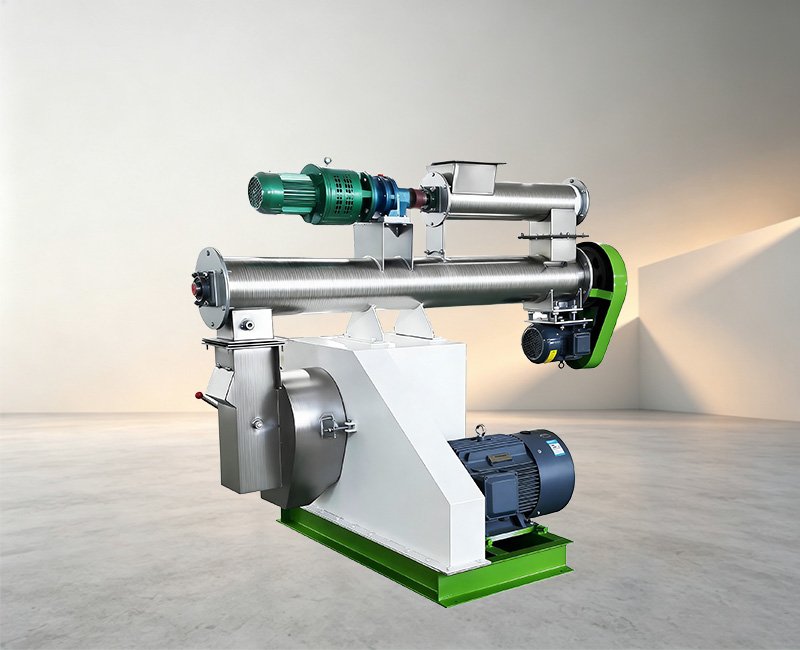
A common mistake is thinking that on-site feed production means buying a pellet mill and nothing else. A pellet mill is the centerpiece, but it is not the whole system. A complete line includes several stages, and each one affects the quality of the final product.
The first stage is grinding. A hammer mill reduces grains and other ingredients to a consistent particle size. The grind affects how well the ingredients mix, how they condition, and how they pellet. If the grind is too coarse, the pellets will be weak. If it is too fine, the pellets may be too dense and less palatable.
The second stage is mixing. A mixer blends the ground ingredients with protein meals, minerals, vitamins, and any additives. The goal is uniformity. Every batch must be identical. If the mixer is not thorough, some birds get too much of one nutrient and not enough of another. The result is uneven growth and poor performance.
The third stage is conditioning. Steam is injected into the mixed material to soften the fibers and activate natural binders. The temperature and moisture must be controlled precisely. Too little conditioning produces crumbly pellets. Too much makes the material sticky and difficult to press.
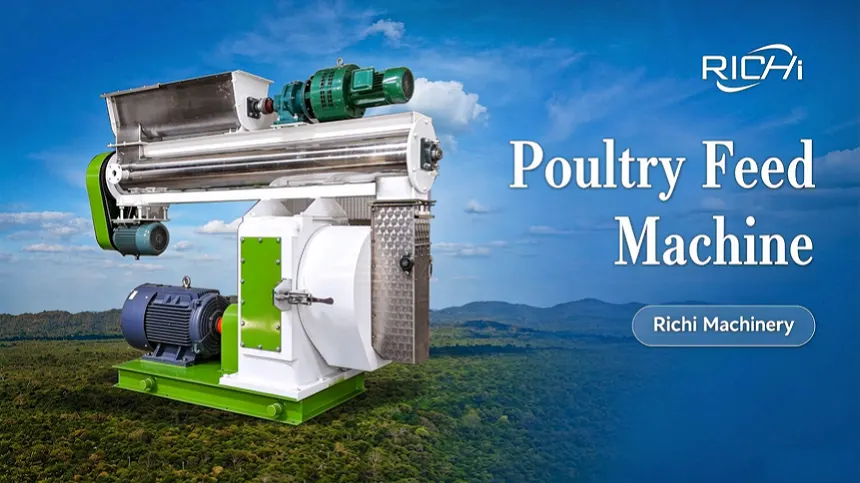
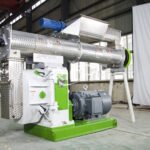
The fourth stage is pelleting. The conditioned material is forced through a die under high pressure. The friction generates heat, which melts the natural lignin and binds the particles into a solid pellet. The die determines the pellet size and density. The rollers press the material through the die. The motor provides the power. The control system keeps everything running smoothly.
The fifth stage is cooling. The hot pellets are cooled to ambient temperature. Cooling hardens the pellets and reduces moisture to a safe level for storage. If the pellets are not cooled properly, they will sweat and mold in storage.
The sixth stage is screening. The cooled pellets are screened to remove fines and broken pieces. The fines are recycled back into the process. Screening ensures that the finished product meets the size and quality specifications expected by the market.
Investing in a poultry feed production line means investing in all of these stages, not just the pellet mill. The integration between them is what determines whether the line runs smoothly or becomes a source of constant frustration.
The Integration Problem
Integration is where many projects fail. It is not enough to buy good machines. The machines must be matched to each other. If the grinder produces more material than the mixer can handle, the line bottlenecks. If the mixer produces more than the pellet mill can process, material piles up. If the cooler is undersized, the pellets do not harden properly. If the screener is inefficient, the final product contains too many fines.
A well-designed line is balanced. Every stage is sized for the same target throughput. The material flows smoothly from one machine to the next with minimal handling. The control system coordinates the stages and adjusts parameters as conditions change. The result is consistent output, lower labor, and higher efficiency.
A poorly designed line is a collection of machines that never quite work together. The operator spends the day adjusting, unclogging, and restarting. Production is unpredictable. Quality varies. Maintenance costs climb. The line may technically function, but it never performs the way it was promised.
That is why it is so important to work with a supplier who understands the whole process, not just one machine. A supplier who can design the line, specify the equipment, and support the installation is worth more than a supplier who simply sells you a mill and wishes you luck.
The Feed Form Question
Before you decide on equipment, you need to decide what kind of feed you are going to make. Poultry feed comes in several forms: mash, pellets, and crumbles. Each has different characteristics and different equipment requirements.
Mash is the simplest form. It is ground and mixed, but not pelleted. Mash is inexpensive to produce, but it has drawbacks. It is dusty, it separates during handling, and birds can sort through it. That sorting leads to nutritional imbalances and wasted feed. Mash is rarely the best choice for commercial production.
Pellets are the most common form for commercial poultry operations. The ingredients are compressed into dense, uniform cylinders. Pellets reduce sorting, improve digestibility, and minimize waste. They flow well through feeders and store efficiently. The pelleting process also gelatinizes starches and improves protein availability. The result is better feed conversion and more consistent flock performance.
Crumbles are simply pellets that have been broken into smaller pieces. They are often used for young birds that cannot handle full-sized pellets. Producing crumbles requires an additional piece of equipment called a crumbler, which is essentially a roller mill that breaks the pellets into the desired size.
The choice between pellets and crumbles depends on the age and type of birds you are feeding. Most operations produce both, using a crumbler for starter diets and whole pellets for older birds. The equipment must be configured to handle both products efficiently.
Choosing the Right Scale
Scale is the most important economic decision. A line that is too small will run constantly, wearing out components prematurely and consuming more labor per ton of output. A line that is too large will sit idle much of the time, tying up capital and increasing the cost per ton of feed produced.
The right scale depends on your flock size, your feeding schedule, and your growth plans. A farm with a few thousand birds might need a line that produces a few hundred kilograms per hour. A larger operation with tens of thousands of birds might need several tons per hour. A commercial feed mill serving multiple farms might need even more capacity.
It is also important to consider the number of shifts you plan to run. A line that operates one shift per day produces less than a line that runs three shifts. If you have room to grow, it may be better to buy a slightly larger line and run it fewer hours than to buy a smaller line and run it around the clock. The larger line will have lower maintenance costs per ton and will give you room to expand without replacing equipment.
Where Suppliers Make the Difference
The equipment is only part of the equation. The supplier behind it matters just as much. A good supplier will help you design a line that fits your operation. They will ask about your raw material, your capacity goals, and your market. They will recommend the right configuration and the right level of automation. They will provide installation, training, and support.
Working with an experienced RICHI manufacture can shorten the learning curve significantly. They have seen what works and what does not. They know which die configurations perform best with different formulations. They know the conditioning parameters that produce durable pellets. They know the maintenance practices that extend the life of the equipment. That knowledge is built into their machines and their recommendations.
Support does not end with installation. Dies wear out. Bearings fail. Belts break. When something goes wrong, you need a supplier who can provide parts and technical assistance quickly. A machine that sits idle waiting for a part is losing money every day. A supplier who responds quickly keeps your line running.
The Economics of On-Site Production
The decision to produce feed on-site is ultimately an economic one. The costs include the equipment, installation, energy, labor, and maintenance. The benefits include lower feed costs, better feed conversion, improved flock uniformity, and greater control over quality.
For many operations, the savings from reduced feed costs alone are enough to justify the investment. When you buy commercial feed, you are paying for ingredients, processing, packaging, transportation, marketing, and profit margins. When you make your own feed, you eliminate most of those layers. You buy ingredients at wholesale prices. You process them on your own terms. The savings can be 15% to 25% or more.
Add the improvements in feed conversion and flock performance, and the returns become even more attractive. Birds that eat consistent, high-quality pellets grow more evenly, convert feed more efficiently, and reach market weight faster. The payback period for a feed production line is often measured in months, not years.
Common Mistakes to Avoid
The first mistake is buying equipment before understanding the raw material. Feed ingredients vary in moisture, particle size, and abrasiveness. A line designed for one formulation may not work for another. Test your ingredients before you buy.
The second mistake is underestimating drying and cooling. These steps are not optional. If the material is too wet, it will not pelletize properly. If the pellets are not cooled, they will spoil in storage. Size the dryer and cooler correctly from the beginning.
The third mistake is choosing a supplier based only on price. A cheap machine may save money upfront, but it will cost more in maintenance, downtime, and inconsistent quality. Look at the whole package: build quality, components, support, and spare parts availability.
The fourth mistake is failing to plan for maintenance. Dies and rollers are wear items. They will need to be replaced. Bearings need lubrication. Belts need replacement. If you do not plan for these costs, they will surprise you.
Related post:https://pelletizerextruder.com/poultry-feed-pellet-making-machine/
Getting Started
If you are considering on-site feed production, the first step is to assess your current feed costs and your production volume. How much feed do you use per month? What do you pay for it? How much could you save by producing it yourself? The answers will tell you whether the investment makes sense.
The second step is to talk to equipment suppliers. Ask about capacity, configuration, automation, and support. Ask for references from other poultry producers. Visit an installation if you can. See the equipment in operation. Talk to the operators. Watch how the line runs. Ask about maintenance and downtime.
The third step is to run a trial if possible. Process a batch of your own feed on a demonstration machine. See how the birds respond. Compare the feed conversion and the waste to what you are seeing now. A small trial can give you confidence before you make a full commitment.
The technology is proven. The equipment is available. The market for organic and specialty poultry products is growing. For producers who are ready to take control of their feed, on-site production offers a practical path. The question is not whether it can work. It is whether it works for you.