
Automation in feed production is often presented as an all-or-nothing decision. Either a mill runs on manual labor with basic equipment, or it invests in a fully automated line with PLC controls, sensors, and central monitoring. In reality, most mills sit somewhere in between. They automate some stages and keep others manual, based on cost, labor availability, and production volume.
Getting that balance right matters. Automate too little, and the mill struggles with inconsistent quality, high labor costs, and bottlenecks. Automate too much, and the mill carries equipment it cannot maintain, cannot fully use, and cannot justify financially.
This article looks at feed mill automation stage by stage. It covers what each stage does, where automation adds the most value, where manual operation still makes sense, and how to think about the investment.
Why Feed Mills Automate
The reasons to automate are practical, not ideological. Mills automate because of labor, consistency, capacity, or safety.
Labor. Feed production involves heavy, repetitive, and sometimes dusty work. Finding and keeping workers for these tasks is difficult in many regions. Automation reduces dependence on manual labor.
Consistency. Manual operation introduces variation. An operator who adjusts a feeder by feel produces different results than one who follows a setpoint. Automation holds process parameters steady, which improves feed quality.
Capacity. Automated lines can run at higher throughput with less downtime between batches. They also handle larger volumes without proportionally more labor.
Safety. Dust, moving machinery, and heavy loads create risks. Automation moves workers away from the most dangerous tasks.
Data. Automated systems generate data. Mills that track energy use, throughput, downtime, and quality can identify problems and improve over time. Manual operations rarely produce this kind of information.
These benefits are real, but they do not apply equally to every stage. Some stages benefit enormously from automation. Others see modest gains that may not justify the cost.
Raw Material Intake and Storage
The intake area is where trucks deliver grain, meals, and other ingredients. In a manual mill, workers unload, weigh, and move materials. In an automated mill, conveyors, elevators, and weighing systems handle the flow.
Automating intake reduces labor and speeds up unloading. It also improves accuracy in weighing, which matters for inventory and cost tracking. For mills that receive large volumes daily, intake automation is usually justified.
Storage automation is less about labor and more about monitoring. Level sensors, temperature probes, and moisture sensors help prevent spoilage and stockouts. These are relatively low-cost additions that deliver real value, especially for mills storing grain over long periods.
For small mills, intake automation may not pay back. A farm receiving a few tons per week can manage intake manually. The calculation changes as volume increases.
Grinding
Grinding is the first real processing step. A hammer mill reduces grain to a target particle size. Manual grinding means an operator controls the feed rate and monitors the mill. Automated grinding uses a controller to maintain a set feed rate and adjust for load.
Automation in grinding delivers two benefits: consistent particle size and stable throughput. Consistent particle size improves pellet quality and digestibility. Stable throughput avoids overloads and downtime.
Grinding automation is relatively simple and inexpensive. Variable frequency drives, feed rate controllers, and basic sensors are widely available. For most mills producing more than a few tons per day, this is one of the first stages worth automating.
Batching and Mixing
Batching and mixing determine feed quality more than any other stage. If the batch is wrong, everything downstream is wrong.
Manual batching means operators weigh ingredients by hand or with basic scales. This is slow, labor-intensive, and prone to error. Small errors in micro-ingredients can have large effects on bird performance.
Automated batching uses weigh hoppers, load cells, and a controller to measure each ingredient precisely. It records the batch, which supports traceability. Automated mixing controls mixing time and discharge, ensuring uniformity.
This is where automation delivers the strongest return. Batching and mixing automation reduces errors, improves consistency, and cuts labor. For mills producing multiple formulas, the benefit is even larger, because the system can switch recipes quickly and accurately.
Pelleting
Pelleting is the most complex stage. Feed is conditioned with steam, pressed through a die, cut, cooled, and dried. Each step affects pellet quality.
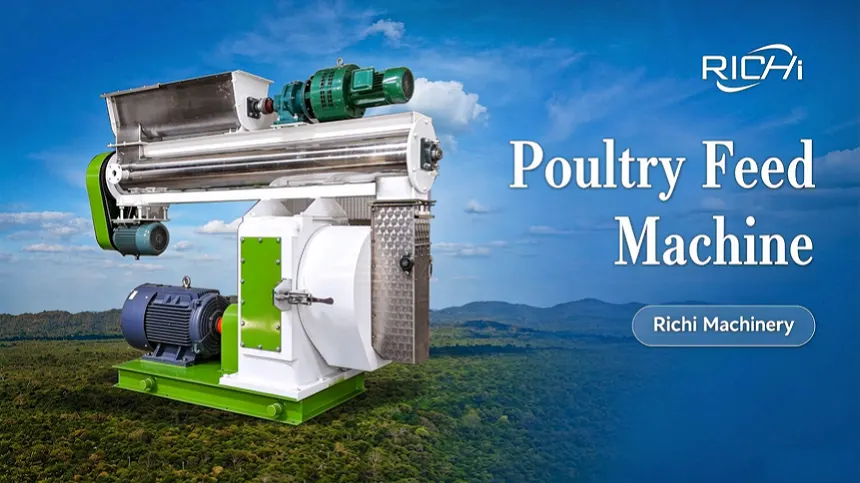
Manual pelleting relies on the operator to adjust steam, feed rate, and die settings. This works, but it depends heavily on operator skill. A good operator produces good pellets. A less experienced one produces soft pellets, high fines, or blockages.
Automated pelleting uses sensors and controllers to maintain steam pressure, temperature, feed rate, and die speed. It adjusts automatically when conditions change. The result is more consistent pellet quality and less downtime.
Pelleting automation is valuable but more expensive than grinding or batching automation. It requires more sensors, more controls, and more maintenance. For mills producing pellets at scale, it is usually worth the investment. For small mills pelleting intermittently, manual operation may be adequate.
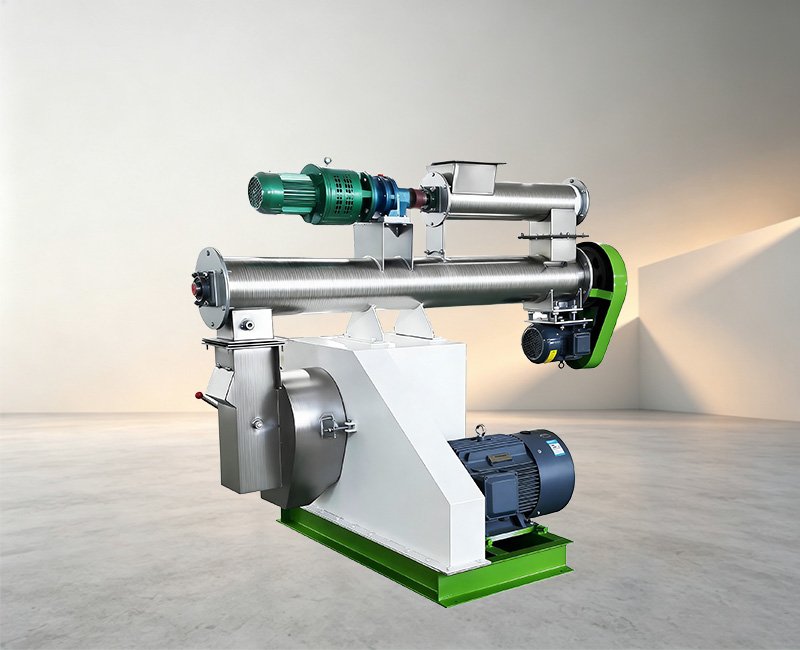
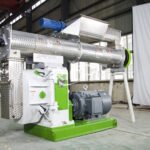
This is where the choice of a poultry feed production machine matters. Some machines are designed for manual operation and basic control. Others come with integrated automation for conditioning, pelleting, and cooling. The right choice depends on the mill’s scale and labor situation.
Cooling, Crumbling, and Screening
After pelleting, feed must be cooled before storage. Hot pellets sweat and mold. Cooling is a straightforward process, but it needs to be controlled. Automated cooling adjusts air flow and retention time based on pellet temperature and moisture.
Crumbling and screening separate usable product from fines. Automation here reduces labor and improves yield. Fines are recycled, which affects capacity calculations.
These stages are often automated together with pelleting, as part of an integrated line. Standalone automation for cooling or crumbling is less common, because the benefits are smaller and the equipment is simpler.
Bagging and Bulk Handling
Bagging is labor-intensive in a manual mill. Workers fill, weigh, seal, and stack bags. It is repetitive, dusty, and physically demanding. Automated bagging uses weighing and filling equipment, sealing systems, and conveyors. It reduces labor and improves consistency in bag weight.
Bulk handling is different. If feed is delivered in bulk, automation means conveyors, silos, and loading systems. The labor savings are large, but the capital cost is also large.
For mills selling bagged feed, bagging automation often pays back quickly. For mills selling bulk feed, the automation decision focuses on loading and transport rather than bagging.
Control Systems and Data
The control system ties automation together. A basic system uses local controls at each machine. A more advanced system uses a central PLC or SCADA system to monitor and adjust the whole line.
Central control offers several advantages. It provides a single view of the process. It records data for quality and maintenance. It allows recipe changes from a central point. It also supports alarms and remote diagnostics.
The cost of central control has fallen in recent years. For mills with multiple processing stages, a central system is often worth the investment. For very small mills, local controls may be sufficient.
Data is the less obvious benefit. A mill that tracks throughput, energy use, downtime, and quality can identify bottlenecks and improve efficiency. Without data, these improvements are guesswork.
Where Manual Operation Still Makes Sense
Automation is not always the right answer. Some stages are better left manual, at least for certain mills.
Small mills. A mill producing a few tons per day rarely justifies full automation. The capital cost is too high relative to the labor savings.
Intermittent production. Mills that run a few days per week may not use automated equipment enough to justify the investment.
Unstable power. Automation depends on reliable power. Mills in regions with frequent outages may find that manual operation is more robust, or may need backup power.
Skilled labor available. If skilled operators are available and affordable, manual operation can be competitive, especially in stages where operator judgment adds value.
Maintenance capability. Automated equipment needs maintenance. A mill without maintenance staff or access to service may struggle with complex systems.
The decision is not “automate everything” or “automate nothing.” It is about identifying the stages where automation delivers the most value for a specific mill.
The Investment Calculation
Automation investment should be evaluated like any other capital decision. The benefits are labor savings, quality improvement, capacity increase, and reduced downtime. The costs are equipment, installation, training, maintenance, and energy.
A simple payback calculation looks at the annual savings divided by the investment. But the calculation should also consider quality and capacity, which are harder to quantify but often more valuable than labor savings alone.
For mills considering automation, the starting point is a clear understanding of current bottlenecks. Automating a stage that is not a bottleneck delivers little benefit. Automating the bottleneck delivers immediate gains.
For mills that want to enter the market with a ready-to-run line, an automatic poultry feed machine for sale is one option, but the level of automation should match the mill’s actual needs. A fully automatic line running at low utilization is worse than a semi-automatic line running at full capacity.
Training and Maintenance
Automation changes the skills a mill needs. Operators move from manual control to monitoring and troubleshooting. Maintenance staff need electrical and control system skills, not just mechanical skills.
Training is often underestimated. A mill that installs automated equipment without training its staff will not get the expected benefits. Operators who do not understand the system revert to manual habits. Maintenance staff who cannot diagnose control issues rely on external service, which is slow and expensive.
Spare parts and service access also matter. Automated systems use specific components that may not be available locally. Mills should plan for this before committing to a particular system.
Scaling Automation Over Time
Many mills automate in stages rather than all at once. This is often the better approach. Start with the stage that delivers the clearest return, then expand as the mill grows.
A typical sequence might be: automate batching and mixing first, then grinding, then pelleting, then bagging. Each stage builds on the previous one. The mill gains experience with automation before taking on more complex systems.
This approach reduces risk and spreads the investment over time. It also allows the mill to adjust its plans based on actual results, rather than committing to a full system upfront.
Conclusion
Automation in feed production is a tool, not a goal. The right level of automation depends on the mill’s scale, labor situation, power reliability, maintenance capability, and production goals. Some stages, like batching and mixing, deliver strong returns. Others, like intake or cooling, deliver smaller returns that may not justify the cost.
The mills that get the most from automation are the ones that identify their bottlenecks, automate those stages first, and build from there. Mills that automate everything at once often end up with equipment they cannot fully use.
For mills that want equipment matched to their automation level and production scale, Richi Pelletizer provides poultry feed production systems ranging from basic manual lines to fully automated plants.