




The transition toward cleaner energy is not simply about replacing one fuel with another. It is also about finding better ways to use resources that are already available.
Every year, forestry operations, sawmills, farms, food-processing facilities, and other industries generate large quantities of organic residues. Some of these materials have limited value in their original form. Sawdust, wood chips, crop residues, and agricultural by-products can be difficult to transport, store, and use efficiently because they are bulky and have inconsistent physical properties.
Biomass pelletization offers one way to address these challenges.
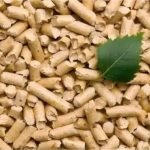
By compressing suitable biomass into small, dense pellets, it is possible to create a standardized solid fuel that can be stored, transported, and fed into combustion systems more easily. This process has become an important part of the broader biomass energy sector.
But how does the process work? Why are pellets useful as a fuel? And does converting biomass into pellets actually improve its energy value?
Let’s explore the science and practical considerations behind biomass pellet fuel.
Why Is Biomass Considered a Renewable Energy Resource?
Biomass is organic material derived from plants, animals, or other biological sources. In the energy sector, the term often refers to plant-based materials such as wood residues, agricultural waste, forestry by-products, and dedicated energy crops.
The reason biomass can be considered renewable is connected to the biological carbon cycle.
Plants absorb carbon dioxide from the atmosphere as they grow. When biomass is later used for energy, some of that carbon is released again. New plant growth can subsequently absorb carbon dioxide, creating a biological cycle.
However, this does not mean that every biomass fuel is automatically carbon-neutral.
The complete environmental impact depends on how the biomass is produced, harvested, transported, processed, and used. Long-distance transportation, energy-intensive drying, land-use changes, and unsustainable harvesting can all influence the overall carbon balance.
For this reason, modern biomass energy discussions increasingly focus on sustainable sourcing and life-cycle emissions, rather than simply classifying biomass as renewable.

What Types of Biomass Can Be Turned Into Pellets?
Not every organic material is equally suitable for pellet production.
Wood residues are among the most widely used feedstocks. Sawdust, shavings, and small wood-processing residues already have relatively fine particle sizes, making them convenient for pelletizing.
Agricultural residues can also be processed into fuel pellets. Examples include:
- Rice husks
- Wheat straw
- Corn stalks
- Sugarcane residues
- Peanut shells
- Sunflower husks
- Cotton stalks
- Other crop-processing residues
The characteristics of these materials can vary significantly.
Wood generally has relatively consistent combustion properties, while agricultural residues may contain higher ash levels or different mineral compositions. Some residues may also contain more silica, which can affect ash behavior during combustion.
Consequently, feedstock selection is not simply a question of what material is cheapest. Availability, moisture, ash content, particle size, energy content, transportation distance, and seasonal supply all need to be considered.
Does Pelletizing Increase the Energy Content of Biomass?
This is an important question because pelletization is sometimes misunderstood as a process that somehow creates additional energy.
It does not.
Pelletizing primarily changes the physical form and density of biomass. The energy contained in the original dry material remains broadly similar, although processing can influence moisture content and therefore the energy available per unit of mass.
The major advantage is that loose biomass can be transformed into a much denser and more uniform fuel.
Imagine a truck loaded with loose sawdust. A large portion of the truck’s volume consists of empty spaces between particles. Once the material is compressed into pellets, the same biomass occupies substantially less space.
This increases the amount of energy that can be transported and stored within a given volume.
Therefore, the value of pellets is not that they magically contain more chemical energy. Their value lies in making existing biomass easier to handle, transport, store, and feed into energy systems.
How Does a Pellet Production System Work?
At its simplest, pellet production involves preparing biomass and compressing it into a standardized form.
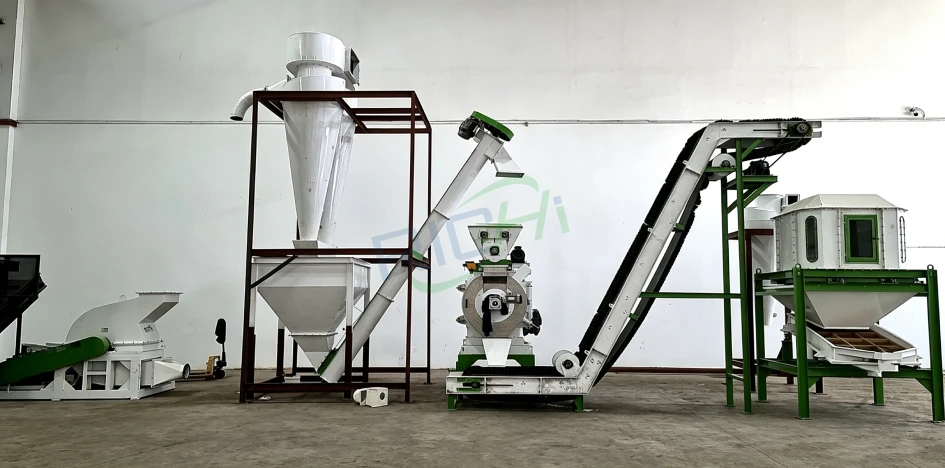
A commercial biofuel pellet production line may include several stages:
Raw material receiving → cleaning → crushing → drying → grinding → pelletizing → cooling → screening → storage or packaging
The exact configuration depends on the feedstock.
For example, dry sawdust may require relatively little preparation before pelletizing. Fresh agricultural residues, on the other hand, may contain excessive moisture and large particles, requiring both drying and size reduction.
This is one reason why there is no universal pellet production configuration.
A system designed for dry wood residues may be unsuitable for wet straw or high-ash agricultural materials without modifications.
Why Does Moisture Control Matter So Much?
Water does not provide useful combustion energy, so excessive moisture reduces the amount of usable energy available per unit of fuel mass.
More importantly, moisture affects the pelletizing process itself.
If biomass is too wet, it may not compress properly and can create unstable operating conditions. Excess moisture can also increase the thermal energy required during drying.
If the material is excessively dry, pellet formation may also become more difficult because moisture contributes to the physical bonding process under pressure.
The appropriate moisture level therefore represents a balance between pellet formation, fuel quality, and drying energy consumption.
This is why moisture measurement is one of the basic analytical steps in a biomass pellet project.
Rather than relying on visual inspection, operators can use moisture meters or laboratory analysis to understand how feedstock conditions change over time.
What Happens Inside a Pellet Mill?
Pelletizing is essentially a process of mechanical densification.
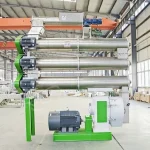
Prepared biomass enters a pellet mill, where rollers compress the material against a perforated die. Under pressure and friction, particles are forced through the die holes and emerge as compact cylindrical strands.
Knives then cut the strands into pellets of a controlled length.
Heat generated during compression can soften certain natural components of biomass, particularly lignin in woody materials. Lignin can contribute to the binding of particles as the material is compressed.
However, pellet formation is influenced by much more than lignin.
Particle size, moisture, feedstock composition, compression ratio, die design, roller condition, and operating parameters can all affect pellet quality.
For this reason, pelletizing is both a mechanical and material-science process.
Related Post: https://commercialpelletmill.com/sawdust-pellet-machine/
Can Different Biomass Materials Be Mixed Together?
Yes, biomass blending is possible, but the materials need to be evaluated carefully.
Combining different feedstocks can sometimes help balance their physical or chemical characteristics.
For example, one material may have good pelletizing properties but relatively high ash content, while another may have lower ash but be more difficult to compress. A carefully designed blend could potentially provide a more consistent feedstock.
However, blending should not be based purely on trial and error.
Different materials may have different moisture levels, particle sizes, ash characteristics, and combustion behavior. The mixture should therefore be tested before being used at commercial scale.
The objective is to create a feedstock with stable properties rather than simply combining whatever residues happen to be available.
What Is the Difference Between Wood Pellets and Agricultural Pellets?
Both are biomass fuels, but they can behave differently.
Wood pellets are commonly produced from sawdust, wood shavings, and other clean wood residues. They are often valued for relatively consistent fuel characteristics and comparatively predictable ash behavior.
Agricultural pellets can be produced from crop residues and processing by-products. Their chemical composition depends strongly on the crop and the part of the plant being used.
For example, some agricultural residues contain higher concentrations of minerals that remain as ash after combustion.
This can affect the design and operation of boilers or heating systems.
Therefore, users should consider the specifications of the actual pellet rather than assuming that all biomass pellets perform in the same way.
Why Are Pellets Easier to Store Than Loose Biomass?
Storage is an often-overlooked part of the renewable energy supply chain.
Loose biomass occupies significant space and can be difficult to move mechanically. Its irregular structure may also make automated feeding more complicated.
Pellets have a relatively uniform shape and can be handled using conveyors, silos, hoppers, and other bulk-material systems.
Nevertheless, pellets are not immune to storage problems.
They should be protected from excessive moisture because water can cause pellets to absorb moisture, lose mechanical strength, and break down into fines.
Storage facilities also need appropriate ventilation, housekeeping, and fire-safety measures.
For large-scale facilities, pellet storage should therefore be considered part of the energy system rather than simply a warehouse requirement.
Does Pellet Production Consume a Lot of Energy?
Pellet production itself requires energy, and this is an important part of evaluating its environmental performance.
The main energy-consuming processes can include drying, grinding, pelletizing, conveying, cooling, and auxiliary equipment.
Among these stages, drying can become particularly energy-intensive when the incoming biomass contains substantial moisture.
This creates an interesting energy relationship: biomass is being processed to produce fuel, but energy is required to manufacture that fuel.
The objective is therefore not simply to maximize production speed. It is to produce pellets efficiently while minimizing unnecessary energy consumption.
Using relatively dry feedstock, recovering waste heat where practical, maintaining equipment properly, and avoiding excessive grinding can all contribute to better energy efficiency.
Can Waste Heat Be Used in Biomass Pellet Production?
In some facilities, heat integration can improve the overall energy balance.
Drying requires thermal energy, while certain industrial processes generate usable heat as a by-product.
Depending on the plant configuration, available heat may be recovered and redirected toward drying operations.
This concept is common across many industrial energy systems. Instead of allowing useful heat to leave the process unused, engineers can investigate whether it can be captured and reused.
The practical feasibility depends on factors such as temperature, heat availability, operating schedules, dryer design, and the distance between the heat source and the drying system.
Energy integration should therefore be evaluated on a site-specific basis.
What Role Does a Pellet Mill Play in the Energy Chain?
A pellet mill is one component within a much larger biomass-to-energy system.
Its role is to densify prepared biomass into a standardized fuel.
Equipment suppliers such as RICHI Pellet Mill operate within this broader biomass processing field, where the performance of pelletizing equipment needs to be considered together with upstream preparation and downstream handling.
From an energy perspective, the important question is not simply how many tons a machine can process per hour.
It is also necessary to consider how much electricity is consumed, how stable the feedstock is, how much maintenance is required, and whether the final pellets meet the specifications of their intended energy application.
In other words, equipment performance should be evaluated as part of the entire energy chain.
How Does Transportation Affect the Environmental Value of Biomass Pellets?
Transportation can significantly influence the overall environmental performance of biomass fuel.
Biomass is widely distributed geographically. A sawmill may produce sawdust in one location, while a pellet plant and energy consumer may be hundreds or even thousands of kilometers away.
Pelletizing can reduce the volume required for transportation by increasing bulk density. However, transportation still consumes fuel and generates emissions.
For this reason, local or regional supply chains can sometimes offer logistical advantages.
A biomass project should examine the complete route from feedstock source to final energy user. The question is not merely whether biomass is renewable, but whether the entire supply chain is resource-efficient.
Is Biomass Pellet Energy Suitable for Every Country?
The answer depends on local conditions.
Countries with large forestry industries may have substantial quantities of wood-processing residues. Agricultural economies may have abundant crop residues. Other regions may have limited sustainable biomass resources and therefore rely more heavily on solar, wind, hydro, geothermal, or other energy technologies.
Climate also matters.
In colder regions, biomass pellets may be used extensively for residential and district heating. In industrial areas, they may serve as a solid fuel for boilers or other thermal applications.
The most appropriate role for biomass therefore varies according to geography, resource availability, infrastructure, energy demand, and environmental policy.
What Should Be Considered Before Building a Pellet Plant?
Anyone planning a biomass pellet project should begin with the feedstock rather than the machinery.
Several basic questions can help establish whether a project is technically practical:
1. How much biomass is available?
The supply should be sufficient throughout the planned operating period, including seasonal fluctuations.
2. What is the moisture content?
Moisture determines whether drying is necessary and influences the energy required for processing.
3. What is the material’s ash content?
High ash levels can affect combustion performance and equipment requirements.
4. How far must the biomass travel?
Transportation can have a major influence on operating costs and environmental performance.
5. What type of pellet is required?
Different users may have different requirements for diameter, durability, moisture, ash, and heating value.
6. Where will the finished fuel be used?
A pellet plant should be designed around a realistic end-use application rather than producing a generic fuel without a clear market.
These questions provide a more useful starting point than simply asking which pellet machine has the highest capacity.
How Can Biomass Pellet Production Become More Efficient?
Efficiency can be improved at several levels.
At the raw-material level, selecting consistent feedstock can reduce unnecessary processing.
At the drying stage, controlling moisture and recovering usable heat can reduce thermal energy consumption.
At the grinding stage, producing an appropriate particle size rather than excessively fine material can help control electricity consumption.
At the pelletizing stage, regular maintenance and suitable operating parameters can help keep production stable.
At the logistics level, locating production facilities close to reliable biomass sources can reduce transportation requirements.
The most effective improvements often come from optimizing the whole system, rather than maximizing the performance of one individual machine.
Final Thoughts: Is Pelletized Biomass a Practical Renewable Fuel?
Biomass pellets demonstrate an important principle in renewable energy: sometimes the challenge is not finding a new resource, but finding a better way to use an existing one.
Sawdust, forestry residues, and agricultural by-products already contain chemical energy. Pelletization changes their physical characteristics, making them denser, more uniform, and easier to handle.
However, the sustainability of pellet fuel depends on more than the final product. Feedstock sourcing, transportation, drying energy, electricity consumption, storage, combustion efficiency, and end use all contribute to the overall energy and environmental balance.
A well-designed biofuel pellet production line is therefore not simply a collection of machines. It is part of a larger biomass-to-energy chain connecting natural resources, industrial processing, transportation, and final energy consumption.
For readers interested in understanding the people and organization behind biomass processing technologies, you can see post on the company’s About Us page to learn more about its background and development.
Ultimately, the role of biomass pellets in the renewable energy transition should be evaluated through the complete life cycle of the fuel. When suitable residues are responsibly sourced and efficiently processed, pelletization can provide a practical way to convert dispersed organic resources into a manageable form of renewable energy.